

- University
- Academic
- Schools/Vocational Schools
- Vocational School of Justice
- Vocational School
- Vocational School
- Department of Banking and Insurance (Turkish)
- Department of Computer Programming (Turkish)
- Department of Foreign Trade (Turkish)
- Department of Graphic Design (Turkish)
- Department of Interior Design (Turkish)
- Department of Construction Technology (Turkish)
- Department of Occupational Health and Safety (Turkish)
- Department of Media and Communication (Turkish)
- Department of Architectural Restoration (Turkish)
- Department of Radio and Tv Programming (Turkish)
- Department of Civil Aviation Cabin Services (Turkish)
- Department of Civil Aviation Transportation Management (Turkish)
- Department of Tourism and Hotel Management (Turkish)
- Department of Applied English Translation
- Vocational School Of Health Services
- Vocational School Of Health Services
- Department of Child Development (Turkish)
- Department of Physiotherapy (Turkish)
- Department of Paramedic (Turkish)
- Department of Opticianry (Turkish)
- Department of Medical Documentation and Secreteriat (Turkish)
- Department of Medical Imaging Techniques (Turkish)
- Department of Medical Laboratory Techniques (Turkish)
- Department of Elderly Care (Turkish)
- School of Applied Management Sciences
- School of Foreign Languages
- Faculties
- Faculty of Arts and Sciences
- Faculty of Fine Arts and Design
- Faculty of Law
- Faculty of Communication
- Faculty of Business
- Faculty of Engineering
- Faculty of Engineering
- Department of Computer Engineering
- Department of Biomedical Engineering
- Department of Electrical and Electronics Engineering
- Department of Industrial Engineering
- Department of Food Engineering
- Department of Genetics and Bioengineering
- Department of Aerospace Engineering
- Department of Civil Engineering
- Department of Mechanical Engineering
- Department of Mechatronics Engineering
- Department of Software Engineering
- Faculty of Health Sciences
- Medicine
- Graduate School
- Common Courses
- Schools/Vocational Schools
- Research
- Research Centers
- Library
- Smart Campus
- Technology Transfer Office
- İzmir Sciencepark
- Continuous Education Center (EKOSEM)
- Children's University
- Ethics Committee
- Teaching and Learning Center (EKOEĞİTİM)
- Psychology Application and Research Center
- Researcher Training Coordinatorship
- Research Collaborations And Innovation Coordinatorship
- Campus
- INTERNATIONAL
- Contact
- 25TH YEAR
Courses
This course covers the fundamental topics of modern probability theory and statistical inference. It addresses probability spaces, random variables (discrete, continuous, and multivariate), expectation, transformations and convolution methods, as well as survival/reliability measures such as the hazard rate and mean residual life. In the statistics component, maximum likelihood estimation, likelihood-based regression, and estimator performance criteria (bias, variance, efficiency, consistency) are examined.
This course covers key concepts and theorems in analysis, focusing on the theoretical structure of single- and multivariable functions, and includes solution methods for systems of linear and differential equations.
This course explores research design and scientific methodology in applied mathematics and statistics. Topics include conceptual frameworks of research, types of inquiry, scientific writing, and ethics in research. Students will learn literature review strategies, principles of report preparation, and manuscript writing in mathematics. The course also emphasizes computational tools and AI-supported workflows for research productivity. Practical sessions include LaTeX, programming environments, and database usage. This course explores research design and scientific methodology in applied mathematics and statistics. Topics include conceptual frameworks of research, types of inquiry, scientific writing, and ethics in research. Students will learn literature review strategies, principles of report preparation, and manuscript writing in mathematics. The course also emphasizes computational tools and AI-supported workflows for research productivity. Practical sessions include LaTeX, programming environments, and database usage. This course explores research design and scientific methodology in applied mathematics and statistics. Topics include conceptual frameworks of research, types of inquiry, scientific writing, and ethics in research. Students will learn literature review strategies, principles of report preparation, and manuscript writing in mathematics. The course also emphasizes computational tools and AI-supported workflows for research productivity. Practical sessions include LaTeX, programming environments, and database usage.
Supervisors and students together will evaluate previous research on the basis of rules of academic writing and discuss how to apply skills related to critical reading, understanding, synthesizing and contrasting and comparing. Students will work together with an assigned instructor on a selected area in their discipline. Students are also required to write a paper/report in this seminar.
This course is designed to independently conduct a research and acquire the necessary competencies. Accordingly, a proper research question is identified under the guidance of an advisor, an extensive literature review is made, and a unique hypothesis and research design are determined by taking into consideration the methodologies and gaps in the literature. Within the framework of the research design, the relevant data is collected and a thesis including the theoretical basis, method, results and discussion of the research is written.
Elective Courses
MATH 524 Discrete Mathematics
This course covers fundamental and advanced topics in discrete mathematics, including Cartesian products, relations and functions, the pigeonhole principle, integer partitions, and exponential generating functions. Emphasis is also placed on solving first- and second-order linear recurrence relations, as well as analyzing nonhomogeneous and nonlinear recurrence relations.
MATH 532 AI-Enhanced Scientific Computing I
This course covers the theory and applications of numerical analysis methods and focuses on the computer-based solution of mathematical problems. The course includes numerical computation, modeling, and programming, as well as the use of artificial intelligence tools in solving numerical problems.
MATH 533 Numerical Methods for Ordinary Differential Equations using Programming Languages
This course introduces the fundamental concepts of error, stability, and convergence in ordinary differential equations (ODEs). Students will learn to implement and analyze numerical methods for both initial and boundary value problems, gaining hands-on experience with computational tools through programming-based assignments, projects, and in-class demonstrations. The course teaches how good programming practices affect the speed and accuracy of numerical solvers.
MATH 534 AI-Enhanced Scientific Computing II
This course covers key topics in scientific computing with integrated AI support. It includes matrix norms and stability, direct and iterative methods for linear systems, numerical differentiation and integration, and fundamental eigenvalue algorithms. The course emphasizes computational efficiency, error analysis, and convergence, supported by AI-based coding and verification tools.
MATH 535 Wavelet Based Methods for Ordinary Differential Equations With MATLAB
This course focuses on the theory and applications of orthogonal polynomials and wavelet-based numerical methods for solving ordinary differential equations. The course covers the use of orthogonal polynomials and wavelet-based approximation techniques in solving ordinary differential equations and error and convergence analysis.
MATH 536 Numerical Methods for Partial Differential Equations Using Programming Languages
This course focuses on the fundamentals of modern and classical numerical techniques for linear and nonlinear partial differential equations, with application to a wide variety of problems in science, engineering and other fields. The course covers the basic theory of scheme consistency, convergence and stability and various numerical methods.
MATH 537 Mathematics and Artifical Intelligence
This course provides a detailed and applied introduction to the mathematical foundations of artificial intelligence. Students learn the mathematical structure of linear algebra, probability and statistics, optimization, machine learning, and basic deep learning, and they implement these concepts using Python.
MATH 538 Mathematical and Statistical Modeling
This course provides a comprehensive introduction to constructing, analyzing, and interpreting mathematical and statistical models for real-world phenomena. Students learn to formulate deterministic and stochastic models using differential equations, optimization structures, probability, and statistical tools. Emphasis is placed on selecting appropriate modeling frameworks and translating theoretical structures into computational implementations. The course integrates hands-on practice with proposed software packages to produce and evaluate model-based solutions. By the end of the course, students will be able to design and communicate robust models through scientific reports and presentations.
MATH 553 Optimization
Linear Programming: Modeling, Solution Methods, Duality in linear programming; Nonlinear programming: First and second order optimality conditions for unconstrained problems, Lagrange multipliers, convexity in mathematical programming, The KuhnTucker theorem; Discrete optimization.
MATH 601 Differential Equations
This course contains the results of linear equations and systems, perturbations of linear systems, the existence and uniqueness of nonlinear initial value problems and the stability theory of linear and nonlinear equations. It also includes the boundary value problems.
MATH 602 Advanced Linear Algebra and Optimization
This course provides essential materials for analyzing advanced mathematical optimization problem forms, models, and applications by introducing the relevant linear algebra concepts.
MATH 624 Introduction to Statistical Machine Learning
In this course, machine learning concepts, supervised learning, classification methods, regression methods, unsupervised learning, clustering methods, and survival analysis topics will be examined.
STAT 501 Theory of Statistics
The topics covered in this course include basic notations and definitions of statistics, data reduction, point estimation, methods of evaluating estimators, and hypothesis testing.
STAT 502 Stochastic Processes
The topics covered in this course include the definitions and the classifications of stochastic processes, Poisson process, renewal theory, Markov chains and processes, Martingales and Brownian motion process.
STAT 504 Nonparametric Statistics
Most of the nonparametric techniques are based on order statistics, runs, and ranks. Therefore the theory of order statistics, runs, and rank statistics is extensively studied.
STAT 553 Reliability
System reliability models and their properties are the focus of this course.
STAT 559 Advanced Probability Theory
The axioms of probability theory and historical probability backgrood are discussed. Random events, random variables as well as their basic characteristics are studied. Limit theorems for sums of independent random variables are also considered. Dependent random variables are studied. Bivariate random variables are discussed.
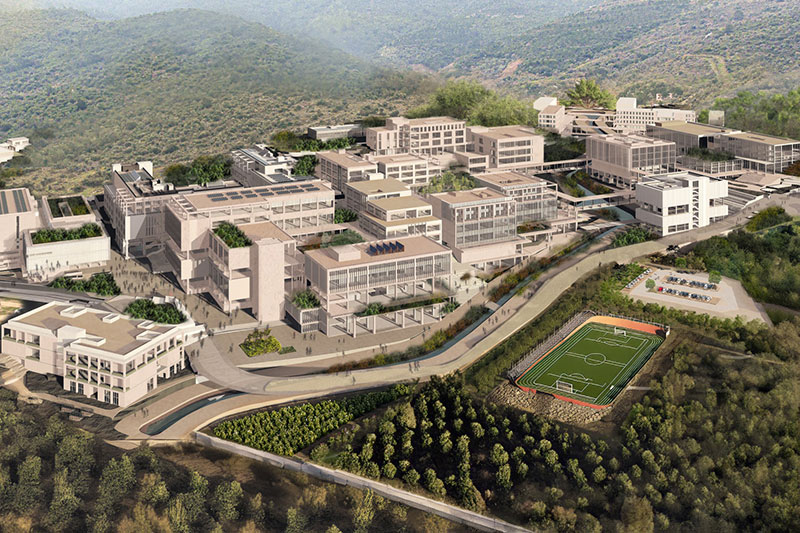
IZMIR UNIVERSITY OF ECONOMICS GÜZELBAHÇE CAMPUS
DetailsGLOBAL CAREER
As Izmir University of Economics transforms into a world-class university, it also raises successful young people with global competence.
More..CONTRIBUTION TO SCIENCE
Izmir University of Economics produces qualified knowledge and competent technologies.
More..VALUING PEOPLE
Izmir University of Economics sees producing social benefit as its reason for existence.
More..