

- University
- Academic
- Schools/Vocational Schools
- Vocational School of Justice
- Vocational School
- Vocational School
- Department of Banking and Insurance (Turkish)
- Department of Computer Programming (Turkish)
- Department of Foreign Trade (Turkish)
- Department of Graphic Design (Turkish)
- Department of Interior Design (Turkish)
- Department of Construction Technology (Turkish)
- Department of Occupational Health and Safety (Turkish)
- Department of Media and Communication (Turkish)
- Department of Architectural Restoration (Turkish)
- Department of Radio and Tv Programming (Turkish)
- Department of Civil Aviation Cabin Services (Turkish)
- Department of Civil Aviation Transportation Management (Turkish)
- Department of Tourism and Hotel Management (Turkish)
- Department of Applied English Translation
- Vocational School Of Health Services
- Vocational School Of Health Services
- Department of Child Development (Turkish)
- Department of Physiotherapy (Turkish)
- Department of Paramedic (Turkish)
- Department of Opticianry (Turkish)
- Department of Medical Documentation and Secreteriat (Turkish)
- Department of Medical Imaging Techniques (Turkish)
- Department of Medical Laboratory Techniques (Turkish)
- Department of Elderly Care (Turkish)
- School of Applied Management Sciences
- School of Foreign Languages
- Faculties
- Faculty of Arts and Sciences
- Faculty of Fine Arts and Design
- Faculty of Law
- Faculty of Communication
- Faculty of Business
- Faculty of Engineering
- Faculty of Engineering
- Department of Computer Engineering
- Department of Biomedical Engineering
- Department of Electrical and Electronics Engineering
- Department of Industrial Engineering
- Department of Food Engineering
- Department of Genetics and Bioengineering
- Department of Aerospace Engineering
- Department of Civil Engineering
- Department of Mechanical Engineering
- Department of Mechatronics Engineering
- Department of Software Engineering
- Faculty of Health Sciences
- Medicine
- Graduate School
- Common Courses
- Schools/Vocational Schools
- Research
- Research Centers
- Library
- Smart Campus
- Technology Transfer Office
- İzmir Sciencepark
- Continuous Education Center (EKOSEM)
- Children's University
- Ethics Committee
- Teaching and Learning Center (EKOEĞİTİM)
- Psychology Application and Research Center
- Researcher Training Coordinatorship
- Research Collaborations And Innovation Coordinatorship
- Campus
- INTERNATIONAL
- Contact
- 25TH YEAR
MCS 501 | Course Introduction and Application Information
| Course Name |
Research Methods in Communication Studies
|
|
Code
|
Semester
|
Theory
(hour/week) |
Application/Lab
(hour/week) |
Local Credits
|
ECTS
|
|
MCS 501
|
Fall/Spring
|
3
|
0
|
3
|
7.5
|
| Prerequisites |
None
|
|||||
| Course Language |
English
|
|||||
| Course Type |
Elective
|
|||||
| Course Level |
Second Cycle
|
|||||
| Mode of Delivery | - | |||||
| Teaching Methods and Techniques of the Course | Group WorkApplication: Experiment / Laboratory / WorkshopLecture / Presentation | |||||
| National Occupation Classification | - | |||||
| Course Coordinator | ||||||
| Course Lecturer(s) | ||||||
| Assistant(s) | - | |||||
| Course Objectives | To present major methodological approaches as well as methods derived from these approaches in communication studies. |
| Learning Outcomes |
The students who succeeded in this course;
|
| Course Description | To be able to formulate sample research projects based on quantitative approaches by differentiating between positivist methodological approaches. |
| Related Sustainable Development Goals |
|
|
|
Core Courses | |
| Major Area Courses | ||
| Supportive Courses | ||
| Media and Management Skills Courses | ||
| Transferable Skill Courses |
WEEKLY SUBJECTS AND RELATED PREPARATION STUDIES
| Week | Subjects | Related Preparation |
| 1 | A general introduction to the course | |
| 2 | Philosophy of Research | Carson, D., Gilmore, A., Perry, C., & Gronhaug, K. (2001). Qualitative marketing research. Sage. Chapter 1 Philosophy of Research (book available in library as electronic resource) ISBN: 9781299642331 |
| 3 | Developing a Research Question | https://writingcenter.gmu.edu/guides/how-to-write-a-research-question https://libguides.gwu.edu/research/question http://sherman.library.nova.edu/sites/tutorials/wp-content/blogs.dir/25/files/2013/09/Creating-a-Research-Question.pdf Asynch |
| 4 | Qualitative Marketing Research : Focus Group Interviewing | Carson, D., Gilmore, A., Perry, C., & Gronhaug, K. (2001). Qualitative marketing research. Sage. Chapter 8 Focus Group Interviewing (book available in library as electronic resource) ISBN: 9781299642331 |
| 5 | Qualitative Marketing Research : Consumer Insight | Parker, J., Koslow, S., Ang, L., & Tevi, A. (2021). How Does Consumer Insight Support The Leap to a Creative Idea?: Inside the Creative Process: Shifting the Advertising Appeal from Functional to Emotional. Journal of Advertising Research, 61(1), 30-43. |
| 6 | Projective Techniques | Campos, A. C., Do Nascimento, T. B., De Oliveira, F. H., Boas, L. H. D. B. V., & De Rezende, D. C. (2020). " Before alone or (well) accompanied"? The Use of Projective Marketing Techniques. The Qualitative Report, 25(2), 471-486. |
| 7 | Interviews | Berger, A. A. (2018). Media and communication research methods: An introduction to qualitative and quantitative approaches. Sage Publications. Chapter 8 ISBN-13: 978-1452256573 |
| 8 | Observation Studies | Carson, D., Gilmore, A., Perry, C., & Gronhaug, K. (2001). Qualitative marketing research. Sage. Chapter 9 Observation Studies (book available in library as electronic resource) ISBN: 9781299642331 |
| 9 | Survey | Lawrence Neuman, W. (2014). Social research methods: Qualitative and quantitative approaches.Chapter 10 Survey Research ISBN: 9780205615964 |
| 10 | Midterm | |
| 11 | Experiment | Malhotra, N., Hall, J., Shaw, M., & Oppenheim, P. (2006). Marketing research: An applied orientation. Pearson Education Australia. Chapter 7 Causal Research ISBN-13: 978-0134734842 |
| 12 | Big Data | Guest and Workshop |
| 13 | Content Analysis | Sloan, L. and Quan-Haase, A. (eds.) (2017). The SAGE Handbook of Social Media Research Methods ISBN: 9781473983847 Chapter 15 |
| 14 | Postpositivism and Positivism | Alakwe, K. (2017). Positivism and knowledge inquiry: From scientific method to media and communication research. Specialty Journal of Humanities and Cultural Science, 2(3), 38-46. |
| 15 | Data Analysis | |
| 16 | Review of the Semester | make up |
| Course Notes/Textbooks | |
| Suggested Readings/Materials | Hallett, R. E., & Barber, K. (2014). Ethnographic research in a cyber era. Journal of Contemporary Ethnography, 43(3), 306-330. Kozinets, R. V. (2002). The field behind the screen: Using netnography for marketing research in online communities. Journal of marketing research, 39(1), 61-72. Zhang, K., Bhattacharyya, S., & Ram, S. (2016). Large-Scale Network Analysis for Online Social Brand Advertising. Mis Quarterly, 40(4). Maslowska, E., Segijn, C. M., Vakeel, K. A., & Viswanathan, V. (2020). How consumers attend to online reviews: an eye-tracking and network analysis approach. International Journal of Advertising, 39(2), 282-306. |
EVALUATION SYSTEM
| Semester Activities | Number | Weigthing |
| Participation |
1
|
10
|
| Laboratory / Application | ||
| Field Work | ||
| Quizzes / Studio Critiques | ||
| Portfolio | ||
| Homework / Assignments | ||
| Presentation / Jury |
3
|
30
|
| Project |
3
|
30
|
| Seminar / Workshop | ||
| Oral Exams | ||
| Midterm |
1
|
30
|
| Final Exam | ||
| Total |
| Weighting of Semester Activities on the Final Grade |
8
|
100
|
| Weighting of End-of-Semester Activities on the Final Grade | ||
| Total |
ECTS / WORKLOAD TABLE
| Semester Activities | Number | Duration (Hours) | Workload |
|---|---|---|---|
| Theoretical Course Hours (Including exam week: 16 x total hours) |
16
|
3
|
48
|
| Laboratory / Application Hours |
16
|
0
|
|
| Study Hours Out of Class |
14
|
3
|
42
|
| Field Work |
0
|
||
| Quizzes / Studio Critiques |
0
|
||
| Portfolio |
0
|
||
| Homework / Assignments |
0
|
||
| Presentation / Jury |
3
|
9
|
27
|
| Project |
3
|
26
|
78
|
| Seminar / Workshop |
0
|
||
| Oral Exam |
0
|
||
| Midterms |
1
|
30
|
30
|
| Final Exam |
0
|
||
| Total |
225
|
COURSE LEARNING OUTCOMES AND PROGRAM QUALIFICATIONS RELATIONSHIP
|
#
|
Program Competencies/Outcomes |
* Contribution Level
|
|||||
|
1
|
2
|
3
|
4
|
5
|
|||
| 1 |
To be able to improve and ultimately deepen the level of theoretical and practical knowledge acquired in the discipline of media and communication studies, |
-
|
-
|
-
|
X
|
-
|
|
| 2 |
To be able to carry on learning and conduct advanced research independently by critically evaluating knowledge in the field of media and communication, |
-
|
-
|
-
|
-
|
X
|
|
| 3 |
To be able to utilize theoretical and practical knowledge at an expert level in the field of media and communication when developing plans, strategies, and policies, |
-
|
-
|
-
|
X
|
-
|
|
| 4 |
To be able to take responsibility in an individual capacity and as part of a team in generating solutions to unexpected problems that arise in the area of communication in daily life, |
-
|
-
|
-
|
-
|
X
|
|
| 5 |
To be able to grasp the interdisciplinary qualities of media and communication studies, |
-
|
-
|
-
|
-
|
X
|
|
| 6 |
To be able to combine the knowledge of the media and communication field with knowledge from various related disciplines to form new knowledge in order to utilize interdisciplinary approaches and research methods to solve critical problems, |
-
|
-
|
-
|
-
|
X
|
|
| 7 |
To be able to critically investigate social relations and the forms and norms of communication that constitute these relations while being to take action to improve and, when necessary, change these relations, |
-
|
-
|
-
|
-
|
X
|
|
| 8 |
To be able to act with special concern for social and scientific values, as well as ethical principles, during the collection, interpretation, and publication of data related to the field of media and communication, and to take action to disseminate these values, |
-
|
-
|
X
|
-
|
-
|
|
| 9 |
To be able to reconstruct a problem in the media and communication field as an academic problem, in order to conduct research, generate methods of solution, and evaluate results, |
-
|
-
|
-
|
-
|
-
|
|
| 10 |
To be able to make use of foreign language for learning new knowledge in the media and communication field and to communicate with foreign colleagues, |
-
|
X
|
-
|
-
|
-
|
|
| 11 |
To be able to communicate systematically, in written, oral, and visual forms, contemporary developments in media and communication to groups inside and outside the discipline, |
-
|
X
|
-
|
-
|
-
|
|
| 12 |
To be able to use computer software required by the discipline and to possess advanced level computing and IT skills. |
-
|
-
|
-
|
-
|
X
|
|
*1 Lowest, 2 Low, 3 Average, 4 High, 5 Highest
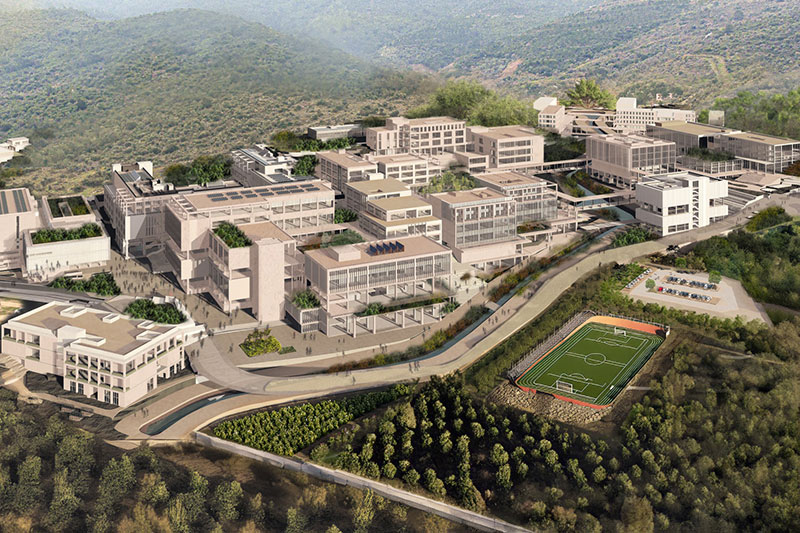
IZMIR UNIVERSITY OF ECONOMICS GÜZELBAHÇE CAMPUS
DetailsGLOBAL CAREER
As Izmir University of Economics transforms into a world-class university, it also raises successful young people with global competence.
More..CONTRIBUTION TO SCIENCE
Izmir University of Economics produces qualified knowledge and competent technologies.
More..VALUING PEOPLE
Izmir University of Economics sees producing social benefit as its reason for existence.
More..